Pausing and Pacing - The Mechanics of Speech Rhythm
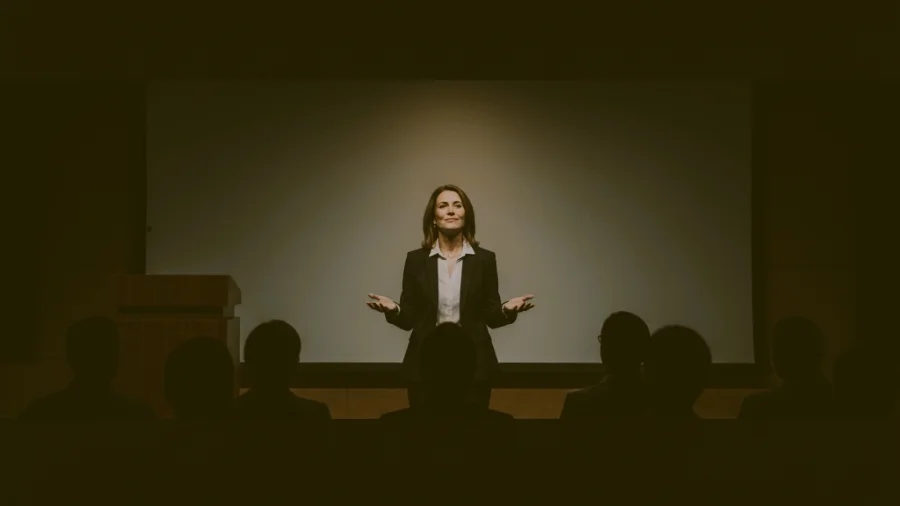
Silence as a Strategic Tool Not a Mistake
For many speakers, silence feels like failure—a void that must be filled with sound to prove they are in control. This instinct leads to rushed delivery and filler words, which undermine clarity and authority. In professional speaking, strategic silence, or pausing, is a deliberate technique used to achieve specific communication outcomes. A well-placed pause performs critical cognitive work for the audience, allowing them to process complex information, absorb emotional weight, and anticipate what comes next.
Mastering the pause requires shifting your mindset from fearing silence to deploying it. It signals confidence, gives you mental space to breathe and think, and transforms your delivery from a monotonous data stream into a dynamic, audience-focused conversation. The discomfort you feel during silence is almost never shared by the audience; they experience it as thoughtfulness and control.
The Three Functional Pauses and How to Execute Them
Not all pauses are equal. Intentional pauses serve distinct purposes and require different timing and placement. Understanding these types allows you to move from random hesitation to planned emphasis.
The Emphasis Pause is used to frame a key idea. Place a 2-3 second pause immediately before a critical statement to build suspense, or immediately after to let its significance land. For example: "After analyzing the data, we found the root cause... [pause]... was a single point of failure in our backup system." The silence amplifies the weight of the revelation. This pause is non-negotiable for statistics, conclusions, and core arguments. The duration must be long enough to feel intentional but not so long that it signals uncertainty.
The Transition Pause structures your talk. Use a 1-2 second pause between major sections of your speech—for instance, after your introduction, before your conclusion, or when shifting between main points. This functions as an auditory paragraph break, giving the audience a cognitive reset and clearly signaling a change in topic. Often, this pause is paired with a deliberate movement or a slide change to reinforce the shift.
The Reflective Pause invites audience engagement. After posing a rhetorical question or presenting a challenging idea, pause for 3-4 seconds while maintaining eye contact. This silence gives the audience time to consider the question internally, creating a moment of shared thought. It is most effective when you can resist the urge to answer your own question immediately. The key is to scan the room during the pause, making brief eye contact with several individuals to maintain connection.
Pacing for Comprehension and Energy Management
Pacing refers to the speed and rhythm of your speech. A constant pace, whether fast or slow, induces listener fatigue. Effective pacing is variable and intentional, matching the cognitive load and emotional tone of your content. The baseline speaking rate for clear comprehension is between 100 and 140 words per minute (WPM). This is slower than casual conversation, allowing for precise articulation and processing time, especially for audiences encountering new information or non-native speakers.
Deviate from this baseline deliberately: increase pace to 150-160 WPM for conveying excitement, recounting quick action, or sharing familiar information. Decelerate to 90-100 WPM when introducing complex concepts, stating critical takeaways, or speaking during moments of gravity or emotion. To practice, record yourself reading a passage with varied content. Mark your script where you intend to speed up (e.g., upward arrow) and slow down (e.g., downward arrow). The goal is to create a vocal "topography" that guides the listener's attention and energy, preventing monotony while ensuring comprehension.
A Practical Method for Integrating Pauses into Your Script
Strategic pausing must be planned, not left to chance during delivery. Use a simple notation system in your speaking notes or script to engineer your rhythm. For a short pause (approx. 1 second), use a single forward slash /. This is often used for a slight breath or a minor phrase break. For a medium, strategic pause (2-3 seconds), use a double slash //. This marks your Emphasis and Transition pauses. For a long, reflective pause (3+ seconds), use a triple slash ///.
Example with annotations: "Our quarterly growth was 15%. // [Pause: let statistic sink in] However, our customer satisfaction score dropped sharply. / [Brief breath] This discrepancy [minor phrase break] is what we must solve today. /// [Pause: allow internal reflection]"
Rehearse with these marks, physically stopping your speech for the full duration. Practice with a metronome to internalize the exact timing. This builds muscle memory, making the pauses feel natural and controlled during live delivery, and directly combats the habit of rushing. Over-rehearsing is better than under-rehearsing for this skill.
Replacing Filler Words with Controlled Silence
Filler words ("um," "uh," "like") typically occur at phrase boundaries or cognitive load points, where you are thinking of the next idea while still speaking. The solution is not to eliminate the thinking moment, but to change its sound from a filler to silence. The targeted practice method involves recording yourself speaking on a topic for one minute. Transcribe the recording verbatim, marking every filler word and the exact moment it occurs.
In your next practice round, your sole goal is to replace each habitual filler with a clean, silent stop. Do not focus on content quality—focus solely on the transition from sound to silence at those junctures. Start with the most frequent filler. If you say "um" before every main point, practice that specific transition in isolation twenty times with silence. This builds the neural pathway that associates a moment of thought with a pause instead of a filler. This skill directly supports Overcoming Anxiety, as it gives you a concrete technique to manage nervous energy in real time, making you sound more composed than you may feel.
Common Pacing and Pausing Errors to Rehearse Against
Even aware speakers make predictable mistakes. Identify and correct these in rehearsal to prevent them in performance.
The Speed-Up Spiral: Nervousness causes accelerated speaking, which reduces clarity, which in turn increases anxiety, causing further acceleration. The antidote is a planned "reset" point in your talk—a specific sentence after which you will force yourself to drop your pace by 20% for the next three sentences. Mark this in your script with a visual cue like [RESET] and practice it until the deceleration feels automatic.
The Monotone Rhythm: Delivering all material, regardless of importance, at the same pace and with identical pause patterns. To fix this, classify each paragraph of your content as either "Concept" (slow pace, longer pauses), "Example" (medium pace), or "Energy" (faster pace, short pauses). Rehearse with these classifications, recording yourself to verify that the differences are audible and distinct.
The Abandoned Pause: Planning a pause but cutting it short mid-execution because the silence feels uncomfortable. Practice with a metronome or timer, holding your planned 3-second pauses for the full duration until the discomfort subsides and is replaced by a sense of control. Have a practice partner signal if you cut a pause short. The goal is to hold silence longer than feels natural in rehearsal, so the performance pause lands correctly.